TWI Job Breakdown Sheet
Build a complete TWI Job Instruction Job Breakdown Sheet with Important Steps, Key Points, and Reasons,
plus the JI 4-step training plan and timetable.
Draft-first: produces the deliverable immediately with [NEEDS GEMBA] for anything unconfirmed.
What a JBS Is (and Isn't)
The trainer prepares from it. The learner never sees it.
A Job Breakdown Sheet is how a trainer prepares to teach one specific job well. It is not a checklist for the learner to follow at the workstation. That's a Standard Work sheet or SOP. The JBS helps the trainer think through the knacks, the safety points, the why behind every key point, before they stand in front of a new operator.
Handing the JBS to the trainee as a reference document. The JBS is a trainer's preparation aid. Once the trainer has studied it, training follows the JI 4-step method, not a reading exercise.
The Three Columns
WHAT → HOW → WHY
The three columns have specific, non-negotiable meanings. Mixing them up is the most common quality failure in a JBS.
Sample JBS
Torque wrench assembly: first three steps
A JBS with placeholder rows after a first draft is telling you exactly where to spend your next gemba time: which steps to watch performed, which specs to confirm with engineering, which knacks to ask the best operator about.
Training Plan Included
JI 4-Step Method: always in the deliverable
The training plan and timetable are required components of every JBS this skill produces, not optional. They are what make this a training tool and not just a documentation table.
Quality Bar
What separates a good JBS from a bad one
Examples
Manufacturing and clinical jobs both supported
Training a new operator to torque a fastener assembly correctly, built from a trainer's verbal walkthrough plus one gemba observation. Includes the full 4-step training plan and a timetable for 4 new hires starting the following month.
"Walk me through how you teach this. Where does the job start? What do new people always get wrong?"
Trainer described 6 steps verbally. Torque spec was not confirmed, so it was marked [NEEDS GEMBA].
Training a new medical assistant on specimen labeling at the point of collection. The skill uses the user's vocabulary: "patient," "collection," "label," instead of manufacturing terms. It also includes the two-identifier verification as a critical Key Point.
The two-patient-identifier check is a Joint Commission requirement and a patient-safety Key Point. The skill flags any JBS for a clinical procedure that's missing safety-critical Key Points.
What you get
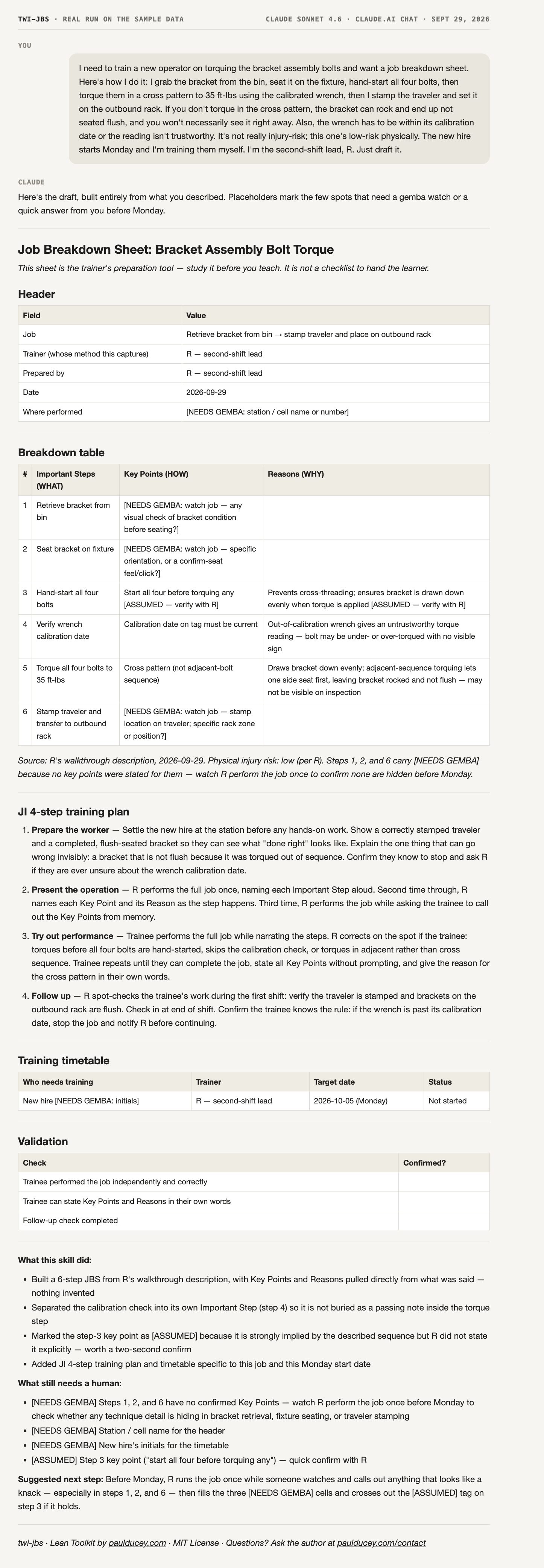
A real run on the sample data
Unedited output. The sample message at the top went to Claude Sonnet 4.6 (an earlier-generation model, so a newer one may word things differently) with this skill pasted in, the same way the steps below show, on September 29, 2026. Scroll inside the frame to read the whole reply.
Installation
Describe the job. Get the JBS.
resources/examples folder.scripts/export_docx.py for a printable trainer's sheet. In a plain claude.ai chat, just copy the answer instead.Related Skills