Root Cause Analysis
Guide structured RCA from problem scoping to verified root cause, using the simplest method that fits. Covers IS/IS-NOT, 5 Whys, fishbone, and barrier analysis. Written to reject operator error as a final answer and to keep a cause tagged as a candidate until it is verified.
The Problem
Surface-level fixes that don't stick
The most common failure in problem-solving isn't a bad solution. It's solving the wrong problem. Teams address the symptom they can see, the fix holds for a week, and the problem comes back. Structured RCA finds the actual cause before anyone proposes a countermeasure.
IS / IS-NOT Scoping
Narrow the problem before the analysis begins
IS/IS-NOT is a two-column table that defines the problem precisely. The contrast between what IS and IS NOT true almost always points directly toward the cause. Knowing the problem only happens on second shift isn't an observation. It's a hypothesis about what's different on second shift.
The problem is shift-specific and time-specific on one machine. The question is no longer "why do we have weld defects." It's "what changes on Line 2 Station 4 after hour 4 of second shift?" That's a much smaller search space.
5 Whys
Chain each cause back to what you can actually fix
5 Whys is the default method for a focused problem with a plausible single causal chain. Each Why must follow directly from the previous answer. Any step whose answer is a person failing is a step that needs to be asked again.
Fishbone (Ishikawa)
Six categories, then drill the top candidates with 5 Whys
Use the fishbone when multiple simultaneous factors are plausible, or when "we don't know where to start." It narrows the field, but a fishbone with no drilled branches is brainstorming, not RCA. Always follow it with 5 Whys on the top one or two candidates.
Healthcare: clinician role clarity, cognitive load, handoff
Healthcare: devices, software, uptime
Healthcare: protocol, workflow, documentation clarity
Healthcare: medication supply, information quality
Healthcare: data definitions, reporting lag, detection threshold
Healthcare: physical space, staffing policy, shift structure
After populating each category, the skill identifies the one or two most probable causes and runs 5 Whys on them. The fishbone is a filter, not a conclusion. You will see "top candidate from fishbone: Machine (chiller capacity)" followed immediately by a 5 Whys chain.
Enforcement Rule
Never accept these as root causes
These phrases close analysis before the real cause is found. The skill always replaces them with a systemic question: what condition set the person up to fail?
Examples
Manufacturing and healthcare both supported
A recurring weld defect on second shift that persisted through two previous "fixes": retraining the operator, then replacing the torch tip. Both were symptoms. The IS/IS-NOT table revealed it was shift-specific and time-specific on one machine, pointing to a thermal management issue.
Problem: Burn-through weld defects at Station 4, Line 2, second shift hours 4–8
Method selected: 5 Whys — single causal chain once IS/IS-NOT completed

W1: Torch temperature 12°C above maximum during those hours
W2: Cooling water flow drops as ambient plant temperature rises
W3: Chiller serving Line 2 undersized for afternoon load (flagged 2023)
W4: Chiller upgrade deferred in capital plan — spec not updated

Root cause [CANDIDATE — needs gemba verification]: Torch temperature spec was written for original
chiller capacity. Reduction in capacity was never reflected in process
controls or detection limits.

Corrective action: Update torch temperature parameter spec and add
real-time temperature alarm — separate work order for chiller upgrade.If the spec is updated and the alarm is in place, does the problem go away? On the evidence so far, yes: the alarm catches the drift before defects occur, and the chiller upgrade eliminates the drift entirely. Both are needed; only the alarm can be done this week. The candidate becomes verified once the alarm is live and second shift's hours 4–8 run clean.
A medication error that reached the patient: a nurse administered the wrong dose. Two previous incidents had been closed as "nurse didn't check the five rights." The fishbone revealed this was a multi-factor problem: a confusingly similar label design, a storage location adjacent to a look-alike medication, and no independent double-check for high-alert medications on that unit.
Problem: Medication error that reached the patient: wrong dose
administered in Room 412. Third similar event in 90 days on this unit.
Method selected: Fishbone (multi-factor) → 5 Whys on top candidates

Fishbone top candidates:
  Method: No independent double-check protocol for high-alert medications
  Material: Label layout nearly identical between 10mg and 100mg vials
  Environment: Look-alike medications stored adjacent in the Pyxis

5 Whys on Method branch:
  W1: Double-check protocol exists but is not required for this drug class
  W2: Drug class was not flagged as high-alert in the unit's medication list
  W3: High-alert list was last reviewed in 2021 and has not been updated
      since two new medications were added to the formulary

Root cause [CANDIDATE — needs pharmacy review]: High-alert medication
list has not been updated to include new formulary additions — the
absence of a required double-check is a policy gap, not a compliance gap.Previous closures blamed the nurse. The skill drilled past "didn't follow the five rights" to find three systemic causes. Two of them (label design, storage adjacency) required no behavior change at all to fix.
How It Works
Scoping first. Simplest method. Verified before closing.
The skill selects the right method for the situation, runs the analysis, and will not close until the verification question is answered.
Describe the problem: what's happening, where, and how often. No form to fill out. If you have data (defect log, incident report, maintenance record), paste it. The skill works with what you give it and marks what's still needed.
The skill always runs scoping first, even briefly. The contrast between what IS and IS NOT true about the problem often narrows the causal search space before any formal analysis begins.
5 Whys for a focused problem with a plausible single causal chain. Fishbone for multi-factor problems or when the team doesn't know where to start. The choice is stated in one sentence with a reason.
Every step where the answer is a person failing gets asked again. "Operator error" is not a root cause. "Lack of training" is not a root cause. The skill drills to what made the correct action harder than the incorrect one.
The skill asks: "If we fix this specific cause, does the problem go away and stay gone?" If the answer isn't a confident yes, drilling continues. The root cause is tagged [VERIFIED] or [CANDIDATE — needs gemba verification], never left ambiguous.
What you get
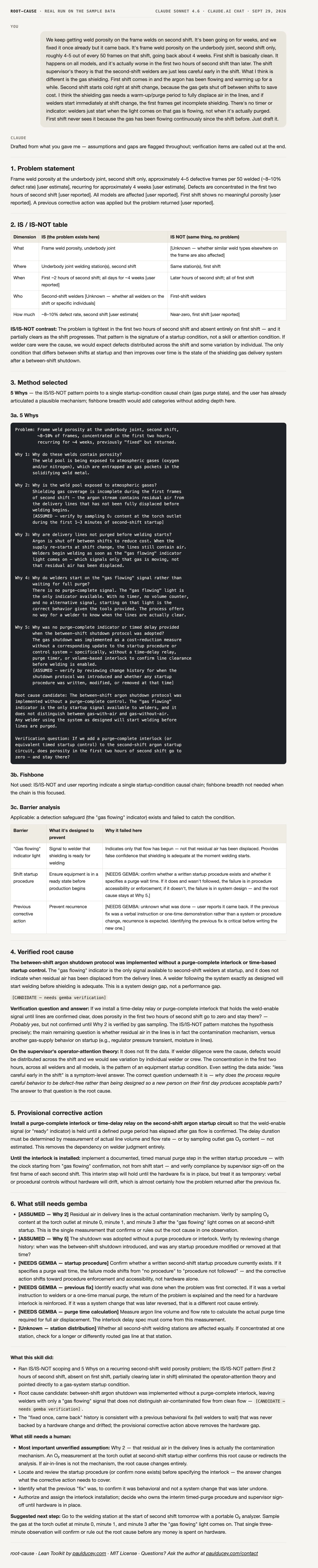
A real run on the sample data
Unedited output. The sample message at the top went to Claude Sonnet 4.6 (an earlier-generation model, so a newer one may word things differently) with this skill pasted in, the same way the steps below show, on September 29, 2026. Scroll inside the frame to read the whole reply.
Installation
No install. Paste it into Claude.
resources/examples folder.No install, no browser extension, no Claude Code required. It's plain text you paste in. The free plan is enough.
Related Skills
When RCA leads somewhere else
A verified root cause often points to an improvement event, a standard-work update, or a VSM to see the bigger picture.