Problem Statement Builder
The most expensive mistake in continuous improvement is solving the wrong problem. This skill scopes the problem correctly before any analysis begins: IS/IS-NOT analysis, SMART output format, and a check against the four common traps.
The IS/IS-NOT Framework
What the problem IS, and what it is NOT
Every problem statement has two sides of equal weight. The IS column describes what you are observing. The IS-NOT column eliminates hypotheses and prevents scope creep. It tells you where to stop looking. A team that knows the problem only happens on the night shift, only at Station 4, and only started three weeks ago has already ruled out half the root-cause list before opening a fishbone diagram.
| Dimension | IS: What we observe | IS NOT: What we can rule out |
|---|---|---|
| Object | Which product, part, patient, or process step is affected | Similar products, adjacent steps, or other product families where the problem does not appear |
| Location | Which line, machine, cell, unit, or geography shows the defect | Other lines, machines, or geographies running the same product without the problem |
| Time | When did it start? Which shift, day of week, or time of day does it appear? | Periods, shifts, or days where it is absent, and what changed around the start date |
| Magnitude | How many defects, how often, how large is the gap from expected performance? | What the problem is NOT doing: it has not spread to other shifts, it is not worsening week-over-week |
- What is happening: a measurable deviation from a standard or expected condition
- Where and when: location, process step, shift, time window
- How big is the gap: actual performance versus expected, with units
Output Format
SMART: the output the skill produces
The skill formats the final problem statement against five criteria before handing it to any root-cause tool. A statement that fails one of these gets sent back for revision, not forwarded to a fishbone with a soft scope.
Common Traps
Four ways teams write the wrong problem statement
How It Works
Describe what you saw. Get a scoped problem statement.
Plain language is fine. "We've been seeing more rejects on Line 3 since last month" is enough to start. The skill asks clarifying questions rather than guessing missing dimensions.
Each of the four dimensions (Object, Location, Time, Magnitude) is filled from what you provided. Anything missing gets an explicit question before the table is finalized, not a placeholder.
The draft statement is checked: is it a solution? a cause? too broad? n=1? Any trap that fires sends the statement back with a specific correction rather than passing it through.
The finalized statement is written in SMART format with source citations for every number. It is ready to paste into a kaizen charter, A3, or root-cause session without revision.
The output includes a summary of what the IS-NOT column has already ruled out, so the root-cause tool starts with a shorter hypothesis list, not a blank fishbone.
Examples
Manufacturing and healthcare both supported
A machined part out-of-spec rate scoped with IS/IS-NOT. The problem started three weeks ago, appears only on the day shift, only at Station 4, and only on the 12 mm bore diameter, not the 8 mm bore on the same part.
The out-of-spec rate for the 12 mm bore diameter at Station 4 (CNC Cell B) is 8% over the past three weeks, versus the 1% baseline from the prior six months. The defect has not appeared at Station 5 (identical operation, different machine) or on the 8 mm bore on the same part. It is present on both operators who run Station 4 but was not present on either operator before the three-week window. Data source: CMM inspection log, 312 inspections over three weeks.
| Dimension | IS | IS NOT |
|---|---|---|
| Object | 12 mm bore, Part #4471 | 8 mm bore (same part), Part #4470 |
| Location | Station 4, CNC Cell B | Station 5 (identical operation) |
| Time | Started ~3 weeks ago; all shifts | Prior 6 months (1% baseline) |
| Magnitude | 8% OOS rate (25/312 parts) | Not worsening week-over-week |
A medication near-miss rate scoped to a specific unit, a specific time window, and a specific drug class. The IS-NOT column rules out the pharmacy, the night shift, and other drug classes, narrowing root cause before the team convenes.
Medication near-miss events involving high-alert oral medications on 4 West are occurring at 3.2 per 1,000 doses administered over the past six weeks, versus the 0.8 per 1,000 baseline from the prior quarter. Events are concentrated in the 6:00–10:00 AM administration window and involve two specific drug classes (anticoagulants and insulin). Events have not increased on other units using the same pharmacy and the same medications, and have not increased during the PM administration window on 4 West. Data source: incident reporting system, verified against eMAR.
What you get
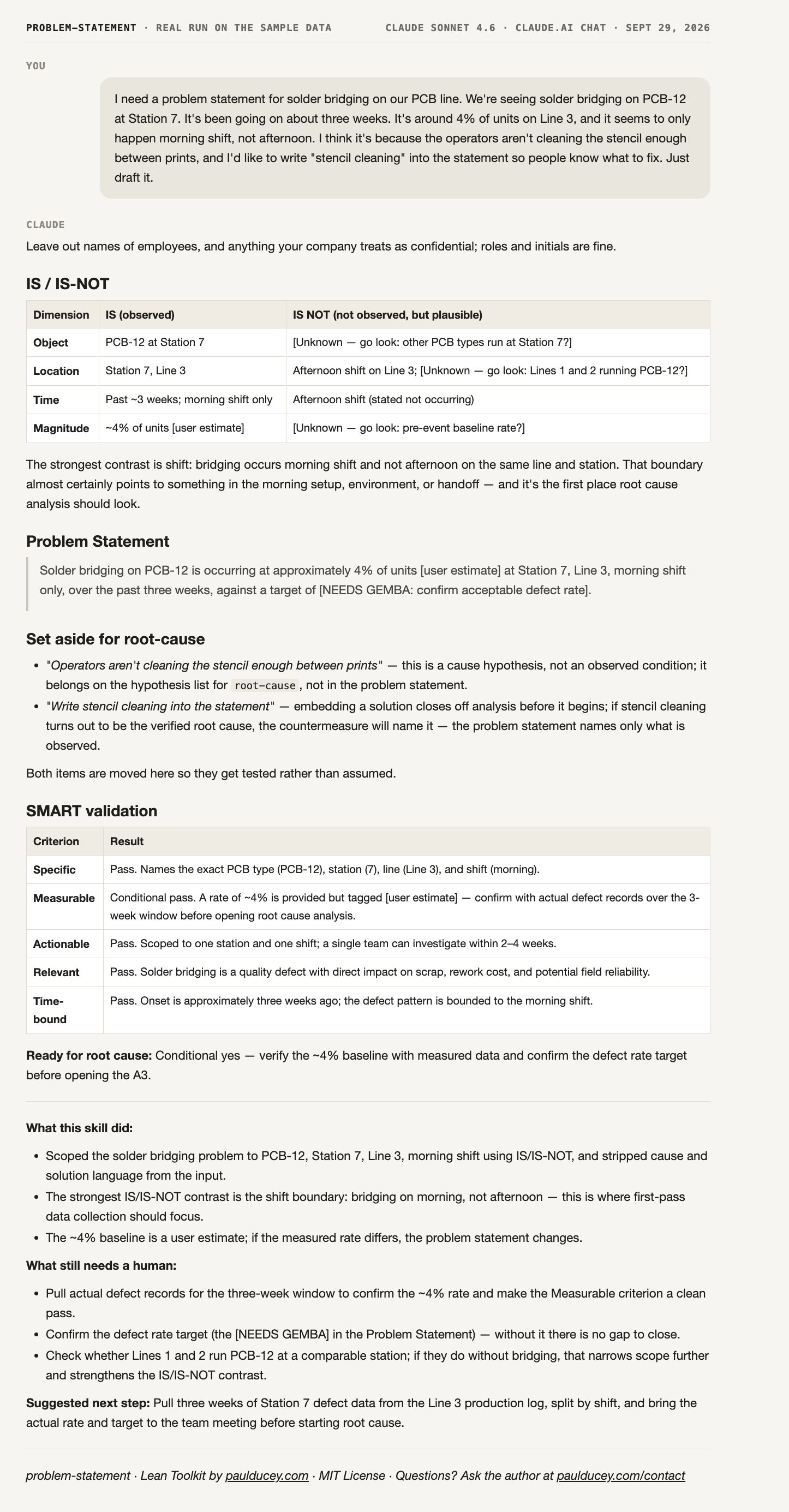
A real run on the sample data
Unedited output. The sample message at the top went to Claude Sonnet 4.6 (an earlier-generation model, so a newer one may word things differently) with this skill pasted in, the same way the steps below show, on September 29, 2026. Scroll inside the frame to read the whole reply.
Installation
Paste it in, describe what you observed
resources/examples folder.Related Skills
Problem scoping leads directly to root cause
A well-scoped problem statement is the input to root-cause analysis. The IS-NOT column gives root cause a shorter hypothesis list to start from.