SMED Setup Reduction
Every minute of setup time is a minute of lost capacity. SMED finds which tasks require the machine to stop, and which ones don't. Separate, convert, streamline. Calculate exactly how much capacity you recover.
The Core Distinction
Internal vs. External: the only question that matters first
Before any reduction effort begins, every changeover task must be classified. This single separation is where most of the time savings come from, not from working faster, but from moving work out of the downtime window entirely.
- Die swap: press must be at bottom of stroke and stopped
- Spindle tool change: spindle must be stopped and locked
- Surgical instrument tray swap: OR must be cleared
- Nozzle replacement: injection molding barrel must be cooled
- Retrieving the next die from the crib: can be done during run
- Completing job paperwork and quality forms: done during run
- Pre-heating fixtures or tooling: started before the stop
- Staging consumables and materials: done at any time
The Three SMED Phases
Separate. Convert. Streamline.
SMED is a three-phase process, and the phases must be done in order. You cannot streamline tasks that haven't been classified. You cannot convert tasks you haven't separated. Teams that jump to "work faster" skip the phases that produce the largest reductions.
- Tooling staged before the stop: retrieved, inspected, and brought to the machine during the prior run
- Next-job paperwork completed during run: setup sheets, quality forms, first-article inspection criteria ready before the stop
- Consumables pre-loaded: materials, fasteners, and supplies placed at point of use before the changeover begins
Sample Output
Task-by-task analysis with conversions and savings
| Task | Duration | Current | Converted | Saved | Notes |
|---|---|---|---|---|---|
| Retrieve die from crib | 12 min | Internal | External | 12 min | Stage during last 30 min of run. No physical reason to stop press. |
| Complete setup paperwork | 8 min | Internal | External | 8 min | Fill out setup sheet and quality plan during run. Operator judgment call. |
| Press die swap | 22 min | Internal | Internal | 0 min | Must be stopped. Reduce with quick-change bolts (Phase 3 candidate). |
| Pre-heat draw ring | 15 min | Internal | External | 15 min | Start pre-heat 20 min before scheduled stop. Bring to temp during run. |
| First-article inspection | 9 min | Internal | Internal | 0 min | Must run parts to inspect. Streamline with pre-set gauges (Phase 3). |
How It Works
Paste your task list. Get back a classified analysis with capacity math.
A list of tasks and their observed durations, from a video review, a stopwatch observation, or operator notes. The skill will ask for any missing durations rather than estimating.
The skill asks a single question for each task: "Does this require the machine to be stopped, or is it performed during stoppage by convention?" Tasks where the answer is unclear are flagged for gemba verification, not guessed.
Every internal task is tested: can it be pre-staged, pre-heated, pre-loaded, or completed during the prior run? Conversions are listed with a specific action: not "move to external" but how to do it.
Tasks that must stay internal are reviewed for parallelization, quick-connect tooling, elimination of adjustments, and standardized sequences. Phase 3 gains are flagged as estimates until verified.
Minutes saved per event × events per year = annual hours recovered. The output includes a before/after comparison and an annualized capacity number to use in the business case.
Examples
Works for stamping lines and surgical suites alike
Stamping press die change. Current total changeover: 66 minutes. Video reviewed; 14 tasks identified. Phase 2 converts 35 minutes of internal to external through pre-staging and pre-heating. Phase 3 targets die-bolting time with quick-change hardware.
task,duration_min,type,conversion,notes
Retrieve die from crib,12,internal,external,Stage during last 30 min of run
Complete setup paperwork,8,internal,external,Fill during run — no stop required
Press die swap,22,internal,internal,Must stop — Phase 3: quick-change bolts
Pre-heat draw ring,15,internal,external,Start pre-heat 20 min before stop
First-article inspection,9,internal,internal,Must run parts — pre-set gauges (P3)

Before: 66 min  After P2: 31 min  Reduction: 53%
Annual (40 changeovers): 23.3 hours recovered
Surgical suite turnover between procedures. "Changeover" in the OR is the time from when one patient exits to when the next patient is ready to incise. Internal tasks require the room to be between cases. External tasks can be done before the prior case ends or in a parallel space.
task,duration_min,type,conversion,notes
Terminal cleaning,18,internal,internal,Must be empty room — streamline sequence
Instrument set assembly,14,internal,external,Assemble next tray in sterile processing during prior case
Preference card review,6,internal,external,Surgeon/team review during prior case
Anesthesia machine check,5,internal,external,Begin check while cleaning in progress (parallel)
Room setup/draping,12,internal,internal,Must be clean — can parallelize with second tech

Before: 55 min  After: 30 min  Reduction: 45%
Annual (1,200 cases): 500 hours of OR time recoveredIn surgical settings the skill adapts terminology: "machine stop" becomes "room between cases," "die change" becomes "instrument tray swap," and "capacity recovered" is expressed in OR hours, a language that resonates with administrators and surgeons alike.
What you get
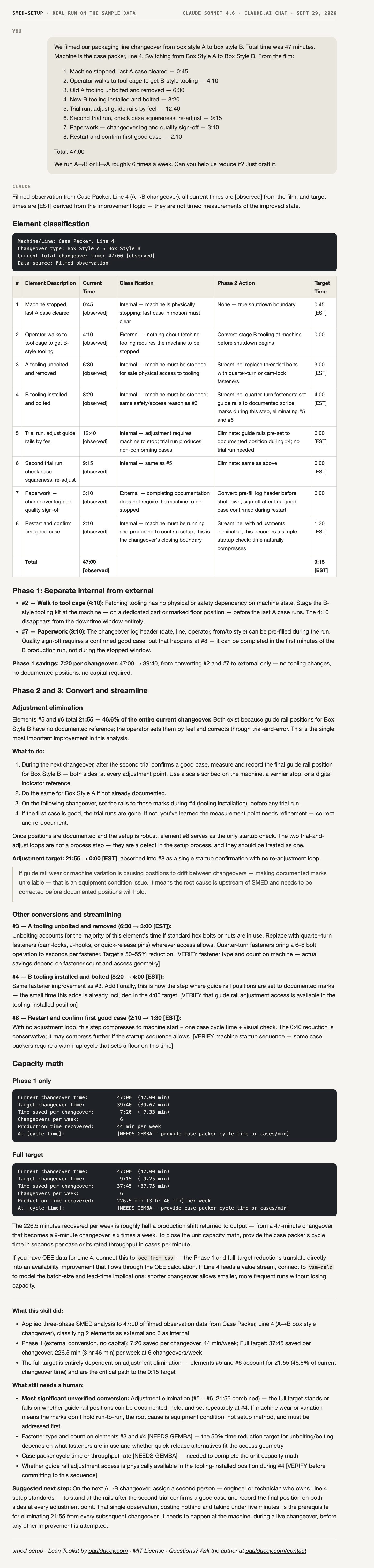
A real run on the sample data
Unedited output. The sample message at the top went to Claude Sonnet 4.6 (an earlier-generation model, so a newer one may word things differently) with this skill pasted in, the same way the steps below show, on September 29, 2026. Scroll inside the frame to read the whole reply.
Installation
Observe the changeover, then run the analysis
resources/examples folder.Related Skills
Shorter changeovers improve OEE and enable smaller batches
Changeover time is a direct input to OEE's Availability factor. Reducing it also enables smaller batch sizes and more frequent replenishment, which reduces inventory in the VSM.